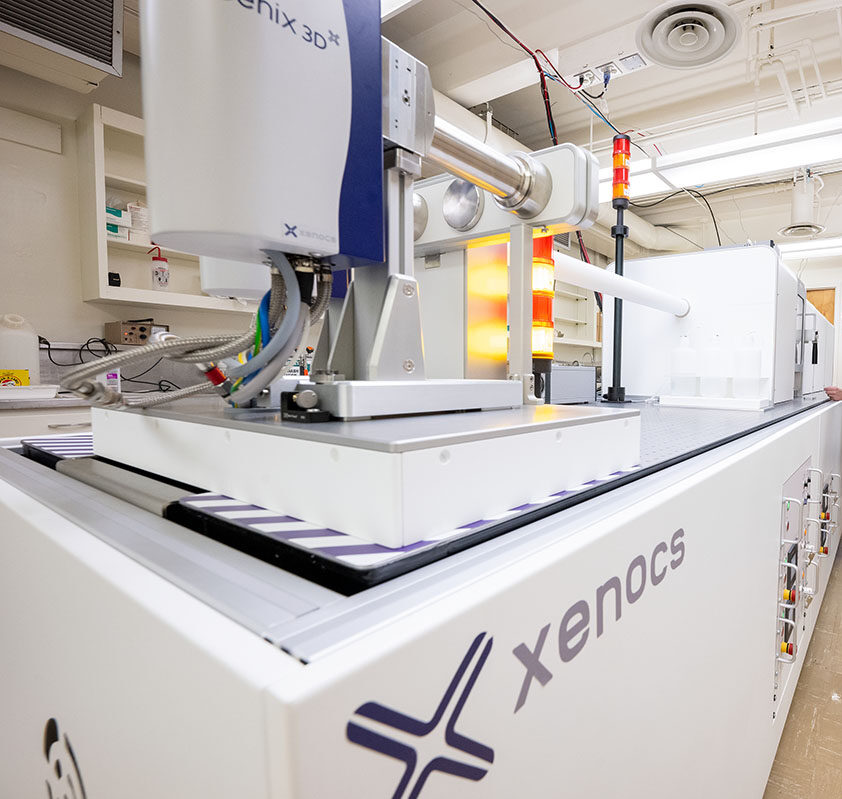
Small- & Wide-Angle X-ray
Xenocs Xeuss 3.0
The NUCS Core Facility has a Xenocs Xeuss 3.0, which is capable of measuring particle size distribution ranging from few nanometers to more than 350 nm in diameter, crystallization rates and lamellar structure of semicrystalline polymers, the size and shape analysis of surfactants or proteins in solutions, the organization and orientation of nanomaterials at atomic or nanoscale, in bulk phases or at surfaces, the phase segregation studies of alloys, and in situ studies of nanostructure transitions. This instrument has four X-ray sources, copper and molybdenum X-ray sources for SAXS measurements, a focused copper X-ray source for grazing incidence measurements, and a copper X-ray imaging tube for imaging a multi-phase material allowing to the ability to probe each phase of a multi-phase material.
Please note that there are additional requirements for training, access, sample submission, and analysis of radioactive samples.
To gain access to this instrument in order to run samples yourself, please check to see if your PI has filled out the NSC User Agreement. If your PI has completed an NSC User Agreement, then please request access or schedule training on the Xenocs Xeuss 3.0 HR below.
Rates
| Description | Instrument Time ($/hr) | Staff Labor ($/hr) |
|---|---|---|
| WSU Clients (Federal Funding) | $ 40.00 | $ 77.06 |
| WSU Clients (Non-Federal / out of Area 35) | $ 40.00 | $ 83.76 |
| External Clients | $ 128.45 | $ 153.58 |
Location
Dodgen Research Facility, Room 114, (509) 335-8641
EMERGENCY: (509) 335-0004
Hours
24/7/365
Facility personnel are available Monday through Friday, 8:00 am to 5:00 pm. Access to the facility is limited to trained instrument users.
Acknowledgement Required
We acknowledge the Nuclear Science Center NUCS Core Facility at Washington State University. Funding for this instrument was provided by the M. J. Murdock Trust, Grant #SR-202016425.
Instrument Status
Available
Layered semiconductor shows potential for next-gen data storage
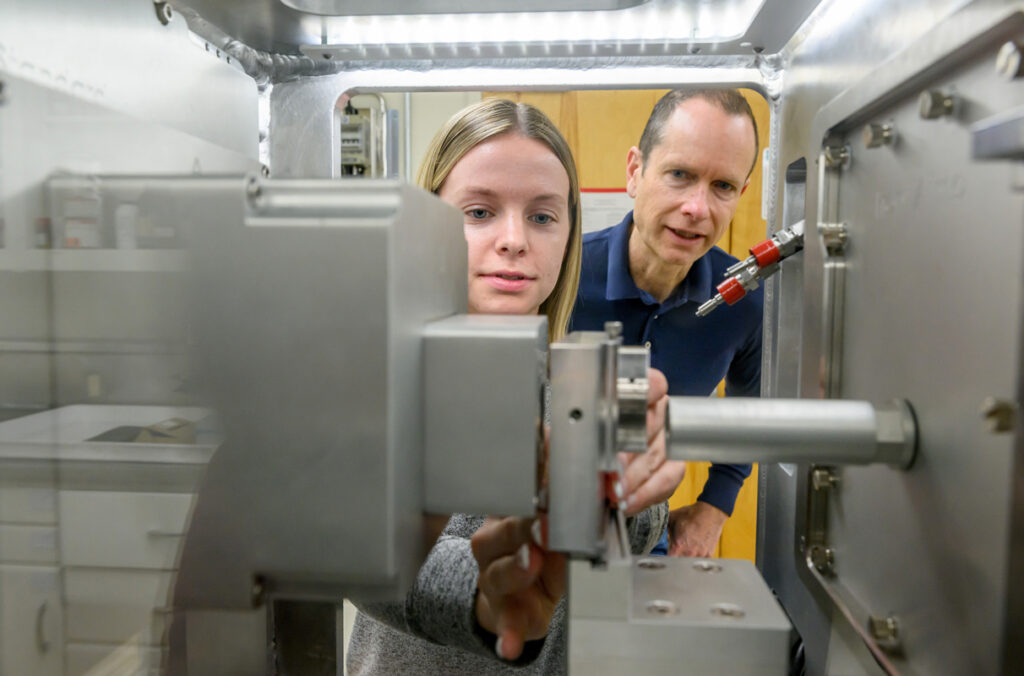
PULLMAN, Wash. — A squishy, layered material that dramatically transforms under pressure could someday help computers store more data with less energy.

Matthew McCluskey named 2025 American Physical Society Fellow
APS Fellowship recognizes members for exceptional original research, significant contributions in the application of physics, and remarkable advancements in education. It is only given to 0.5% of the entire APS membership.